


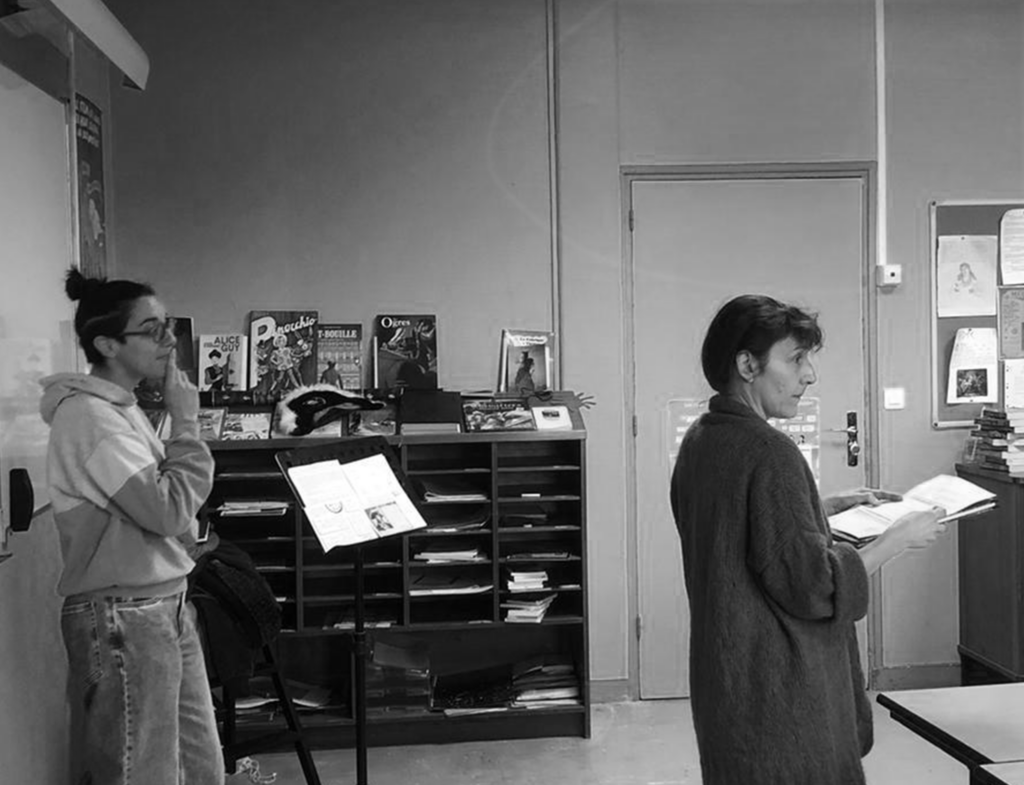
Sixth and seventh hearings in the Medea case at Albert Vinçon middle school
This time, it is time for confrontation. After several weeks of investigation, preparation of testimonies, and development of defense strategies, the students have finally reached a new stage in the fictitious trial: the mutual cross-examination. For two hours, the classroom was transformed into a true courtroom, where the groups faced each other in a series of rapid exchanges organized like a judicial speed-dating.
A well-oiled mechanism to keep the floor moving
To structure the debates, each group divided roles among its members: a spokesperson, responsible for answering questions; an interrogator, responsible for conducting the cross-examination; and a clerk, responsible for recording the answers obtained. In the room, three hearing spaces were set up. The principle is simple: 7 minutes and 30 seconds of interrogation for the first group; 7 minutes and 30 seconds for the reverse response; then a change of tables for a new confrontation. Between each round, a five-minute break allows the groups to catch their breath, prepare their next interrogation sheet… and collect their thoughts. A bell sets the pace for all the exchanges.
More lively debates than expected
Very quickly, the dynamic sets in. The students, visibly well-prepared, fully embrace the exercise. Questions fly. Objections follow one after another. Groups push further, dig deeper, and search for contradictions. Encouraged to go beyond their prepared questions, the students do not hesitate to improvise in order to exploit their opponents’ weaknesses. The result: exchanges that are engaged, structured, argumentative, sometimes funny, and often fiercely contested.
When role-playing becomes almost too real
The intensity of the session, however, reveals a new difficulty: by dint of embodying their characters, some students sometimes struggle to maintain the distance between the role-play and personal involvement. Defending Medea, Jason, or Creon against repeated accusations becomes a true exercise in posture. Some feel attacked beyond the role they are portraying. Others invest themselves with such conviction that the exchanges become particularly passionate. Between two rounds, the facilitators therefore take the time to recall the fundamentals: the distinction between a critical argument and a personal attack, the importance of active listening, and the necessity of maintaining a respectful framework for debate.
A demanding… but decisive session
The setup proved to be particularly intense: a sustained pace, constant concentration, a high noise level, and strong cognitive and emotional mobilization. This energy also bears witness to the remarkable engagement of the students in the activity. The teacher, who had continued the preparatory work in class between the sessions, was able to see how much the students had taken ownership of the trial’s argumentative stakes.
A case that is increasingly difficult to decide
At the end of this session, one thing is clear: each character now has a solid and coherent defense. Medea’s trial no longer looks like a simple search for guilt. It is becoming a complex exploration of viewpoints, interests, and contradictory narratives.
Next step: toward the verdict?
The cross-examination is now complete. The testimonies have been confronted. Positions are clarified. Contradictions have emerged. The file is approaching its conclusion. But at the Albert Vinçon middle school, one question remains more open than ever: in this case, can we still point to a single guilty party?