


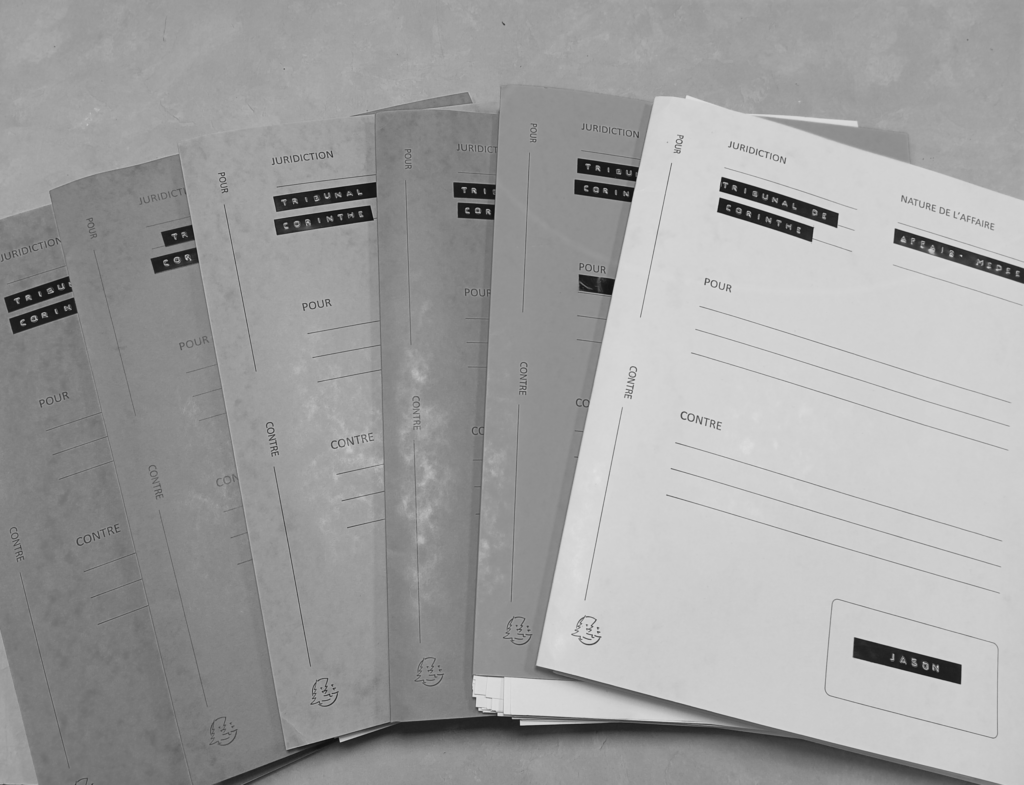
Fifth hearing in the Medea case at Albert Vinçon middle school
As the confrontation between witnesses approaches, tension is rising: students are no longer just defending their character, they are now refining their defense strategy. For one hour, the 30 students involved in the fictitious trial worked to prepare their answers for the upcoming cross-examination, the final step before the grand oral confrontation scheduled for the next session.
Ten questions to put the witnesses to the test
Each group received a central document for the remainder of the proceedings: an interview preparation sheet, compiling ten questions formulated by the other groups based on the testimonies from the previous session. In total: two questions per character-group; ten questions to be addressed by each team; and a single objective: to build solid, coherent, and convincing answers.
Defend without lying
The instruction has remained unchanged since the beginning of the trial: anything is allowed to defend one’s character… except lying. Students are therefore encouraged to deploy all the mechanisms of argumentation: emphasis; pathos; irony; turning an argument around; avoidance strategies; and the indirect accusation of other protagonists. The work no longer consists solely of understanding the text, but of using it as argumentative material.
First alliances in the courtroom
Throughout the session, a new dynamic appeared: students began to reason in terms of collective strategy. Some groups identified converging interests between characters and are already envisioning forms of implicit alliances. Among the connections observed: Jason and Nerine seem to share certain defense interests. A notable evolution showing that students are no longer content with analyzing their roles in isolation: they are beginning to think of the trial as a complex relational system, where responsibilities are negotiated, shifted, and shared.
A growing immersion in the logic of the trial
This argumentation session marks a new progression in the appropriation of the project. The students: adopt the point of view of their character more and more spontaneously; refine their strategic reading of the play; develop more nuanced reasoning; and deepen their understanding of the dramatic tensions of the work.
Preparation that will continue outside the hearing
The time allotted did not allow for the finalization of all answers. The work will therefore continue independently with the teacher during an intermediate session, without the facilitators, in order to allow each group to complete its preparation before the next hearing.
Next step: judicial speed-dating
During the next session, the groups will enter the direct confrontation phase: each character will have to defend their version of the facts against the others in a series of rapid exchanges organized like a real judicial speed-dating. The Medea trial is about to change its pace!